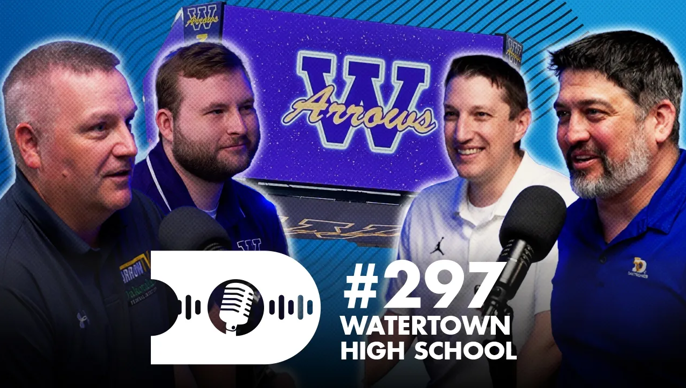
Watertown High School Is Building More Than Broadcasts
Watertown High School’s Arrow TV program shows what can happen when students are trusted with real responsibility. What started with a few cameras has grown into a student-led broadcast program that’s building skills, confidence and future careers.
Matt Anderson on 5/13/2026
Categories: High School Sports

I walked away from this conversation thinking less about cameras, displays or software and more about what happens when you give young people the chance to try something real.
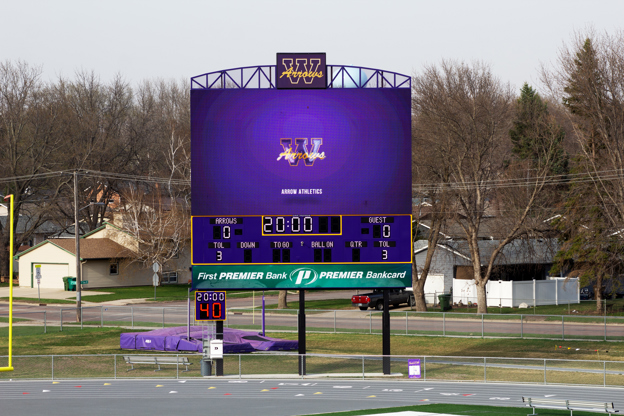
Watertown High School’s Arrow TV program didn’t start as a polished production operation. It started with a few kids, a lot of curiosity and a simple question: What can we do with these new video boards? From there, it grew into one of the most robust high school sports production programs in the region, run largely by students and shaped by a mindset of experimentation.
What stood out to me most was how intentional the program is about keeping students at the center of everything.
“We try to stay out of the spotlight and let it be the kids as a learning experience,” said Ryan Remmers, Arrow TV Coordinator.
That mindset shows up in how the crew operates on game nights. Students run cameras. Students learn replay. Students handle in-house graphics. They rotate roles, test their interests and slowly build confidence doing work that looks a lot like what you’d see at the college or professional level.
Starting Small, Then Letting It Snowball
Arrow TV didn’t begin with seven cameras and instant replay. It began with graphics, a scoreboard and a handful of borrowed or donated cameras. Over time, as interest grew and support followed, so did the complexity of the production.
“You start out with one or two cameras and pretty soon it’s a seven or eight camera production,” Ryan added.
That growth wasn’t forced. It happened naturally as students wanted to do more and as the community supported them – from donated equipment to local sponsorships that helped turn volunteer hours into paid opportunities.
Now, students are showing up not just because it looks cool, but because they see where it could lead.
“Some of them didn’t know this could be a career. And once they found out it could be, that’s what they want to do,” commented Austin Thompson, Watertown School District Technician in their IT office.
Learning by Trying (and Sometimes Failing)
One of my favorite takeaways from the conversation was how openly Ryan and Austin talked about trying things just to see what would happen. Sometimes it worked. Sometimes it didn’t. And that was kind of the point.
They’ve tested alternate broadcasts, unique camera angles and crowd engagement ideas borrowed from much bigger stages. When something didn’t work, they adjusted and moved on.
“It’s high school sports. If it doesn’t work, at least you tried it,” said Austin.
That freedom matters. For students, it’s a safe environment to take risks. For the program, it’s how innovation happens.
It’s Bigger Than Sports
Not every student involved in Arrow TV is an athlete, and that’s by design. The program gives students a reason to be part of game night even if they’re not on the court or field.
“It gives them something meaningful to do for their school. And they’re learning skills they can use later,” added Ryan.
Some students discover an interest in broadcasting. Others find they like graphics, directing or technical setup. A few realize they want to pursue sports media in college. Even those who don’t want that still walk away with confidence, experience and a better sense of what they enjoy.
Advice Worth Repeating
Near the end of the conversation, Ryan offered advice that felt like the thesis of the entire program: “Start small. Build from there. And keep it about the kids.”
That’s really it.
Arrow TV works not because it’s the flashiest setup or the most expensive gear, but because it’s rooted in trust. Trusting students to learn, to try and to grow into something bigger than they expected when they first picked up a camera.
And honestly, that’s the kind of story I never get tired of hearing.
To listen to the full conversation, check out our video podcast!