6 Takeaways from the 2026 National Sports Forum
What we’re seeing across sports venues today reflects the same themes discussed at the National Sports Forum—from fan-first storytelling to data-driven engagement and connected venue experiences.
Matt Anderson on 3/18/2026
Categories: Pro Sports and Colleges

What I’m Still Thinking About After the National Sports Forum
I spent a few days last month at the National Sports Forum in St. Louis. Like most conferences, you leave with a notebook full of bullet points, half ideas, and things you want to look into later.
Working in sports technology, it’s always interesting to compare what people talk about on stage with what we’re actually seeing happen inside venues.
Here are a few themes that stuck with me.
1. Know the story you’re trying to tell
One comment early in the conference stuck with me:
“What is the vision of what you believe you can build?”
That question framed a lot of the conversations throughout the week. Teams and organizations aren’t just promoting games or events. They’re building platforms that allow them to tell bigger stories.
Another thought that followed was simple but powerful:
Put points on the board so everyone knows.
That resonated with me because so much of what we do in venue technology is literally about helping teams tell those stories in the moment. Whether it's a replay, a fan cam, or a sponsor activation, the display becomes the canvas for that storytelling.
2. The best sports marketing moments are emotional
One breakout session with the Cleveland Browns talked about a goal they call “Owning the Moment.”
Their idea is to create high-impact moments that drive:
- Fan emotion
- Partner value
- Cultural relevance
One example was the Dawg Pound XL campaign tied to a partner activation with Dude Wipes.
The reveal gained even more attention when Pat McAfee talked about it on The Pat McAfee Show.
Moments like that reminded me how much of sports marketing now happens across platforms simultaneously. In-venue experiences, social media, and broadcast are all feeding the same moment.
3. Collaboration beats silos
Another interesting operational detail came from how teams organize internally.
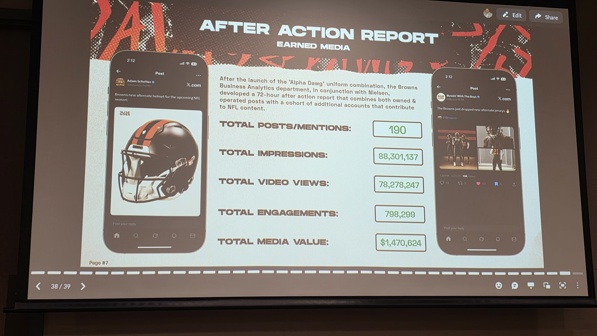
The Browns marketing team talked about using structured workflows with tools like Asana and having marketing liaisons embedded with other departments like creative and digital.
Every activation also gets an after-action report within 72 hours, including:
- Impressions
- Engagement
- Video views
- Media value
It made me think about how many different groups have to work together for even a single moment in a venue. Content teams, marketing, production, sponsorship, and technology are all touching the same experience.
When those groups are aligned, the results feel seamless to fans.
4. Sports marketing is psychological
One session had a blunt headline:
“We sell nothing fans actually need.”
Sports isn’t a necessity. It’s emotional, tribal, and psychological.
A line from that session stuck with me:
Relevance beats reach every time.
That idea shows up in venue experiences too. The moments that get the loudest reaction in an arena usually aren’t the biggest graphics or flashiest animations.
They’re the ones that connect with fans in that exact moment.
5. Stadiums are turning into districts
The mixed-use development panel focused on something we’re seeing across the industry.
Teams aren’t just building stadiums anymore.
They’re building destinations.
The goal is to increase dwell time so fans stay longer before and after events.
That includes:
- Restaurants and entertainment districts
- Transit instead of massive parking decks
- Public-private funding partnerships
- More integrated fan experiences throughout the campus
From a technology standpoint, that also means the experience isn’t limited to the bowl anymore. Digital displays and content now extend across plazas, districts, and surrounding spaces.
6. AI is quickly becoming part of the workflow
Another session focused on building an AI playbook around fan data and engagement.
The framework they discussed looked like this:
Data → Engage → Nurture → Qualify → Handover
Some examples included:
- AI-driven follow-ups when fans engage with an email or ad
- Virtual assistants answering quick questions
- Retargeting based on content engagement
The big takeaway wasn’t any specific tool.
It was the mindset:
Don’t treat AI like a fad. Build it into your process.
Final thought
Like most conferences, I came home with more questions than answers.
But a few themes kept repeating throughout the week:
- Tell better stories
- Create moments fans care about
- Build experiences, not just venues
- Measure what works
- Start integrating AI now instead of waiting
Working with venues across sports, it’s interesting to see how many of these ideas are already showing up in real projects.