Street Furniture Displays Are Evolving and Here’s Why That Matters
Street furniture displays are evolving alongside out-of-home advertising needs. Advances in LED resolution, durability and flexibility are redefining how digital street-level displays are used across campuses, transportation hubs and public gathering spaces.
Matt Anderson on 5/1/2026
Categories: Out of Home Advertising, Pro Sports and Colleges, Spectaculars, Transportation

When we talk about innovation at Daktronics, it is not always about launching something brand new. Sometimes it is about revisiting a product that has been out in the world for years and making it better, more flexible and more aligned with how people engage with spaces today.
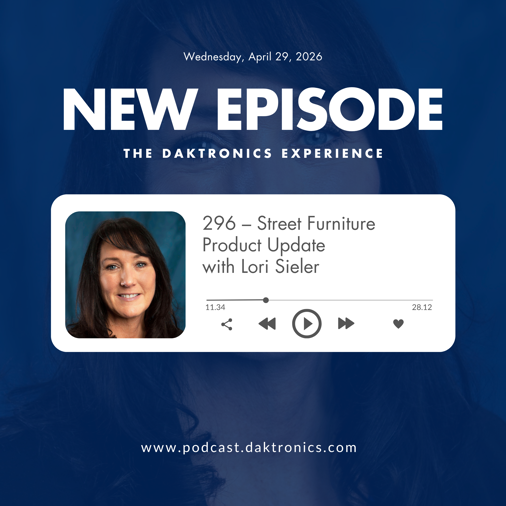
That is exactly why Justin and I sat down with Lori Sieler, one of our product managers, on a recent episode of The Daktronics Experience podcast. We talked about street furniture displays, how they are being used today, and what has changed over the last several years to make them an even stronger solution across multiple markets.
What Do We Mean by Street Furniture?
When we say street furniture, we are talking about digital displays designed for street-level engagement. You’ll usually see them in places like bus shelters, outdoor malls, campuses, entertainment districts and transportation hubs. These are displays people can walk up to, stop at, and actually interact with, not just drive past.
Lori explained that street furniture has traditionally competed with LCD screens in these spaces. LCDs still have their place, but LED technology has opened up new opportunities, especially when it comes to durability, uptime and long-term ownership costs.
Why LED Street Furniture Is Gaining Momentum
One of the biggest advantages of LED street furniture is resilience. In the advertising world, uptime matters. When an LCD fails, the entire screen often goes dark. With LED, even if there is a small failure, the display is usually still communicating a message.
Recent advances in chip-on-board technology have also been a game-changer. Over the last five years, higher resolution options have become much more realistic for these applications. We are now talking about pixel pitches down to 1.5 millimeters, which allows street furniture displays to deliver the clarity, color depth and visual quality people expect from modern digital experiences.
Put that technology inside a protected enclosure, and suddenly you can place LED displays in semi-outdoor environments where they may not have made sense before.
Flexibility Across Markets and Applications
One of the things that stood out to me during the conversation was just how versatile street furniture displays have become.
We talked about installations at college campuses, transportation systems and high-profile venues. Each one uses street furniture differently. Some use it for wayfinding, others for event information, branding, advertising or even campus safety communications.
I shared a few real-world examples during the episode. At South Dakota State University, we used mobile street furniture displays during College GameDay to help with wayfinding and event messaging. The ability to move displays where they were needed, with minimal infrastructure, made a big impact.
Another example was Texas A&M University, where street furniture was originally installed without advertising. The idea was simple. Put the displays in place, show their value and let sponsors come asking how they can be part of it. It worked. That visibility helped demonstrate how powerful these displays could be before monetization even began.
Designed With Service in Mind
Ease of service is another area where LED street furniture shines.
Replacing a large LCD often requires heavy equipment, lane closures and a significant amount of time. With LED street furniture, servicing usually means swapping out a small tile using basic tools. In some cases, that tile fits right in your hand.
During the podcast, Justin reminded listeners that he has literally watched me swap out a module on site in minutes. If I can do it, trust me, it is designed to be straightforward. That simplicity helps reduce downtime and lowers service costs over the life of the display.
New Capabilities, Same Core Idea
Street furniture displays have been around for a while. Some of our early installations date back to 2014. What is new today is improved resolution, better durability and more flexibility for customers who want to refresh existing enclosures instead of starting from scratch.
Instead of replacing an entire structure, many customers can retrofit LED into an existing cabinet. That approach saves money, reduces waste and modernizes the experience without a full rebuild.
Stepping Back and Watching the Audience
One of my favorite moments in the conversation was when Lori talked about observation. If you want to know whether street furniture makes sense for your space, watch how people move through it. Watch where they gather. Watch what catches their attention.
Street furniture works best when it complements how people already behave. It should feel like a natural part of the environment, not something competing with the device in someone’s hand. High-resolution LED displays make that balance possible and open the door to creative messaging, calls to action and even things like QR codes to extend engagement.
Listen to the Full Conversation
This blog only scratches the surface. Lori shared a lot of insight into how street furniture has evolved, where it fits today and how customers can think differently about activating their spaces.
If you want the full story, I’d encourage you to listen to the entire episode of The Daktronics Experience podcast. I’ll link to the episode below so you can hear the full conversation.